Wednesday, June 16, 2021

ICELAND DAY 5 – ROCKS AND ICE AND SNOW AND JEDI


(readers note: I changed the format, so the pictures follow the relevant paragraphs.  Be sure to read all the way to the end.  Click on any picture to see all the pictures in full size)

It’s cold and windy when we wake up.  June be damned, they named this place ICEland, so we knew what we were getting into when we signed up.  But we’re here, Iceland is here and we have the gear for it, so out the door we go.  It’s just a short drive to Myrdalshreppur where we park and hike 45 minutes to the tongue of the Solheimajokull glacier.  We learn two things about glaciers. First, they are massive.  Academically, we knew this before, but when you see one in person, you’re still surprised.  The leading edge wall of ice here is 300 feet high, and our pictures just can’t capture the enormity of the thing.  Second, glaciers are really dirty.  Not litter or trash, but as the ice moves towards the sea, it picks up dirt and rocks and volcano ash so in some places there is a zebra stripe effect and others it’s just black.  When you look higher up, you see more of the snow-white-caps you expect.


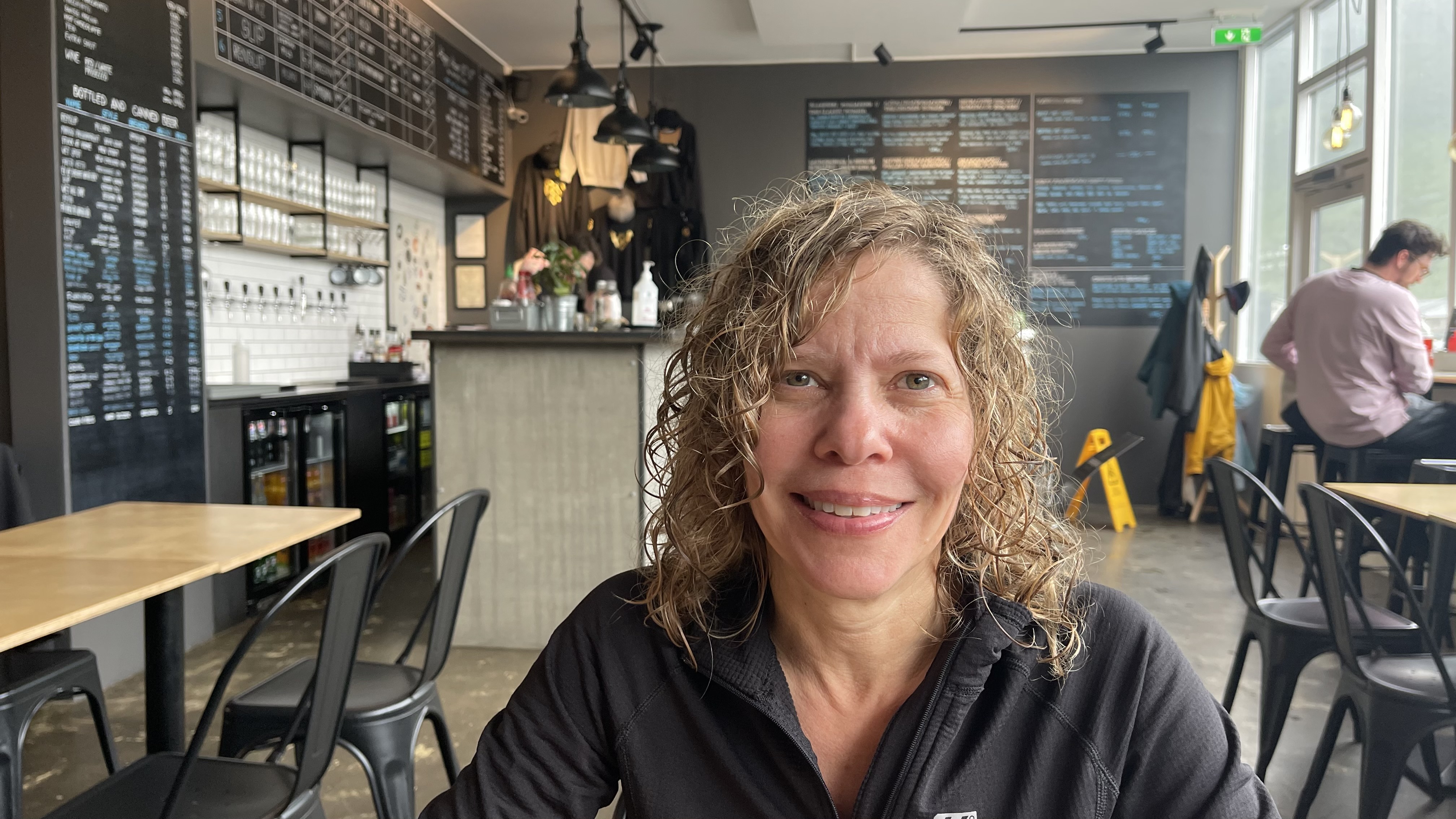
As we get back into the car, the weather is getting worse, so we head to Vik.  Going over the mountain into town the snow starts to accumulate quickly.  Just after the peak there is a car tilting precipitously off the edge of the road and a wrecker is already there to pull him back.  Somehow swimming is a favorite sport in this frozen country and every town has a public pool of some sort, typically heated by the geothermal steam that is readily available here.  We finish the decent and head to the pool in Vik, which looks like a complex you can find in suburban towns across the States.  Except this one is open year round, and today’s snow is simply business as usual.    We sit outside in the warmest of the tubs, 40C, as the snow falls on our faces and cold wind blows our hair.  On the mountain between us and the North Atlantic, we see a pair of hikers fighting mightly against the elements to try to scale to the summit.  We discuss how our idea for today is better than theirs.  A dip in the cool pool and a few minutes in the natural steam room and it’s time for lunch.  Smidjan Brugghus for some local brews and good burgers.  We strike up a conversation with the Americans at the next table and tell them about the pool.  We get a good laugh when we realize they were the people we saw trying to hike the mountain.


Heading back east, the weather clears just enough for us to stop at Hjorleifshofdi.  This place is now commonly referred to as the Yoda Cave, as the opening to the cave resembles the Jedi master so much that part of Rogue One: A Star Wars Story was filmed there.  The cave is a tall quarter sphere that’s fun to explore while doing your best Yoda impression for a few minutes and the pix are very social worthy.  On the west side of the same mountain, we find the Hjorleifur hike, a UNESCO site which take you to the mountaintop grave of Iceland’s first settler.  The path is easily identifiable, but only 9” wide in most places and very steep.  The most challenging here for us so far, but fun and with great views.


Our last stop in the area is the Black Sand Beach.  Mandy has been all about this one, but I’ve been skeptical.  She was right.  Even in a country with great geology, this site is a standout.  As you walk closer to the sea, the ground changes from fist size smooth black rocks to smaller smooth black stones to course black diamonds to silky fine black sand that your feet sink into with every step.  Surrounding the beach are the basalt columns, tall sheer cliffs of deep black stone that resemble some over-exaggerated Dr. Seuss rendition of a pipe organ.  Two final columns jut into the sky just past the breakers.  We’re amazed how much fun rocks can be and spend almost an hour exploring and walking.


Tuesday, June 15, 2021

ICELAND DAY 4 – ICELANDIC SUMMER (SATURDAY 10AM to 3PM)


(readers note: I changed the format, so the pictures follow the relevant paragraphs.  Be sure to read all the way to the end.  Click on any picture to see all the pictures in full size)

We planned this trip so we could experience the midnight sun, the time of year where it’s light 24 hours a day.  For example, today the sun will dip below the horizon at 5 minutes after midnight, then rise again 1:47am.  It’s been strange adapting to a place that’s never dark, waking in the middle of the night and not knowing if it’s 3am or 3pm because they look exactly the same.  It’s also Islandic Summer, with temperatures usually in the high 50s, calm winds and blue skys.  So far this trip has been cold and rainy, but today we realized that summer here is beautiful.  And only lasts for 5 hours.

We take advantage of this summer day by hopping the ferry to the Westman Islands, a chain of 16 islands off the southwest coast of the country.  At about 5 square miles, Heimaey is by far the largest of these islands and the only populated one, a town of 4300 inhabitants.  It’s an island fishing village built on a volcano, with all the other commerce of the town as support of the one industry.  Given the harsh environment and isolation, I was expecting a rough-and-tumble kind of place, but like the rest of Iceland it seems to fight the elements with civility and ingenuity.  For example, you make your own fun here.  Our tour starts with a visit to the training cliff, where dozens of local kids under 10 are being taught Spranga, a local hybrid sport of rope climbing, rappelling and rope swing.  There are 2 goals in this sport: 1) climb hundreds of feet up sheer rock faces on the adjacent islands to steal bird eggs and 2) not to die.  Our guide is 6’2”, 250lbs, grabs the long rope and adroitly climbs up 50 feet in a split-second.  Pushing off, he swings left in a graceful arc and lands expertly on a 10-inch-wide rock shelf on the far other side of the cliff.  Lining himself up, his next leap is a breathtaking headfirst with a full flip and 2-and-a-half rotations, landing back where he started.  We understand instantly that he’s a local, proud to show off his unique town. Next stop is the natural amphitheater and golf course, where we watch local birds nesting in the rock wall and I see the world’s most dastardly par 3: tee box, lava fields, small green surrounded by water. 


We drive in search of Puffin, the adorable black and white birds with colorful beaks.  To get to our vantage point, we walk through fields of local sheep, friendly types who happily follow and bleat and approach us for snacks of stale bread our guide brings along.  The gulls and ducks are plentiful, but the puffins are harder to find.  When we do see them they are whizzing by, headed out to sea to bring fish back to the nest.  We didn’t expect something that cute to be that fast.  At the top of the mountain we stop at the windiest place in Europe, but today is summer in Iceland, and it’s warm and calm and sunny.  Next is the ash fields, the newest 30% of the island created by the months long 1973 volcano eruption.  Our guide tells us about when he, his family and the entire island were evacuated for 5 months.  Really interesting hearing history from someone who lived it.  Our final stop is the animal sanctuary, where we get up close with a rescued Puffin (awwwwww!) and a pair of rescued Beluga whales (ohhhhhhh!)


Sometime during the 45-minute ferry ride back, summer comes to an abrupt end.  It’s colder and windy on the mainland now.  We stop to check out Skagafoss, the 160-foot-tall waterfall near our hotel.  The Stairmaster at our gym did not prepare us for the steep winding steps to the top, and we’re both panting by the time we get there.  Totally worth the effort as this vantage point offers views of the feeder river, the top of the falls and a panoramic all the way to the sea.  It’s a gorgeous landscape in a series of gorgeous landscapes.  Hedding east, we stop at Dyrholaey, the massive natural arch and nearby lighthouse.  We turn off of Route 1, the two-lane ring highway around the country, and go a few clicks on a typical unpaved road of crushed lava rock.  At the end of the road we drive the narrow switchbacks up the side of the mountain.  With every turn, it feels like we’re just going to drive off the side of the earth.  At the top, the wind is a constant 50mph and we hold onto each other to not be blown away.  We enjoy the sites despite the weather, but with the winds this fierce and the rains starting, it’s not safe to walk across the top of the arch, so we make due with some good pictures.


The next “big town” east is Vik, the southernmost village in Iceland sporting a population of 300.  Despite the population, the town is the hub for commerce for 50 miles in either direction, featuring 2 gas stations, a proper supermarket, a scattering of businesses and a handful of very nice restaurants.  We choose The Soup Company, a vibey café that also hosts a live lava show.  We order the signature Lava Soup, a bright red beef goulash in a bread bowl, and traditional Icelandic Meat Soup.  Mandy says this is the north Atlantic version of Jewish chicken soup, good for the soul and perfect to warm the weathered traveler.  It’s getting late (but not dark) and we head back to the Umi.  The lobby bar is vibey, the remnants of two big parties in the restaurant tonight.  We take the corner table next to the big windows overlooking the dormant volcano for a daylight nightcap, the expertly mixed cocktails finally winding us down from our long day.


Sunday, June 13, 2021

ICELAND DAY 3 – WATERS ON THE DIAMOND


(readers note: I changed the format, so the pictures follow the relevant paragraphs.  Be sure to read all the way to the end.  Click on any picture to see all the pictures in full size)

Although the locals use the term “fire and ice” all the time, this island is really about the water.  The water melting off the glaciers colors every facet of daily life.  Of course, there’s the excellent drinking water, and iconic white-snow peaks that are the wallpaper to daily life.  But when a volcano erupts, and they do frequently around these parts, the people worry less about lava and fire and ash (which cause damage to relatively few) and more about water.  The eruptions tend to quickly melt the glaciers, causing massive, devastating flooding.

Checked out of our hotel, today we’re all about the prettier, happier water, heading out to see the waterfalls, geological features and other sites of the Golden Circle.  The consummate day trip for travelers staying in Reykjavik, the Golden Circle is a 140-mile loop on the western side of the country that takes you to some absolutely beautiful sites.  Our first stop is Thingvellir National Park.  This is the Philadelphia of Iceland, the site where Iceland’s (and the world’s) first parliament was formed in 930.  But today, we’re here for the geology, as this is also the place where the North American and Eurasian tectonic plates violently meet.  It seems that North America is winning, sliding up over the Eurasian plate and forming a tall, course, sheer cliff.  It’s the only place in the world where this North Atlantic Ridge is visible on land.  Walking beside it and looking down into the deep fissures caused by it, you can feel the brute power of the land masses.  Our easy 2-mile hike ends at the Oxararfoss waterfall, a broad cascade whose pool empties right into one of the main fissures.


Seeing water fall, it’s time to see it rise.
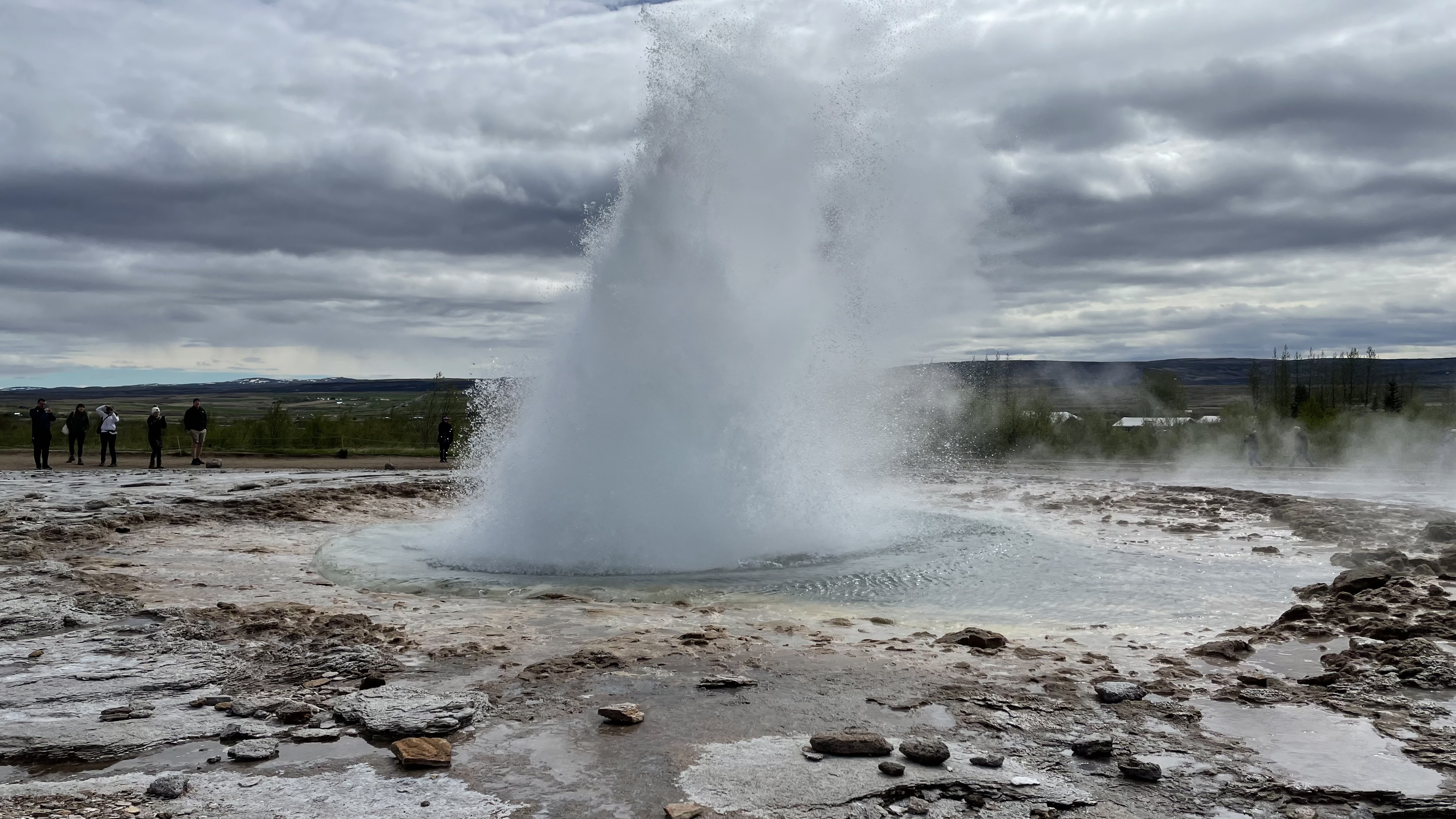
  we head to Geyser, the geothermal “park” about an hour away. These days, Geyser itself rarely guises, its former glory taken over by Strokker just a few dozen yards away.  Strokker has been reliably guising every 5 minutes or so for a decade, but like a box of chocolate, you never know what you’re gonna get.  Some eruptions aren’t much more that a tub fart, while others can go 60 feet high.  We get the entire range in the half hour we spend there, plus take a look at the bubbling hot springs that dot the landscape.


Next stop is Gullfoss, one of the most picturesque waterfalls in Iceland.
  Well, actually two of them, which makes it so fun to see.  The upper fall is broad and curved, the water crashing 33’ into the top of the lower fall.  The lower fall is about twice as high and dumps into a deep fissure that becomes the ensuing river.  The roar and force are palpable, and the constant mist spray makes this a literally immersive experience.  The waterflow can fill an Olympic swimming pool every second, and Mandy assumes that instead of counting “one Mississippi, two Mississippi” the local kids time hide-and-seek with “BAM-one-olympic-swimming-pool, BAM-two-olympic-swimming-pools”.  Ask her to do it for you next time you see her.


A 20 minute Kia ride down the road is Faxi, a smaller, wider waterfall.  Even though we’re getting hungry, it’s so easily accessible that we can’t resist.  We pull in, are the only people there and park about 10 yards from the water.  It’s the most peaceful place we’ve been in Iceland, just us, the falls and wild purple nootka (Alaskan Lupine) flowers.  It’s relaxing, so we watch and listen and be for a while.  Dipping my hand into the waters, it only takes a split-second to remember what they call this country.


2pm and close to hangry, we get to Fridheimar, our lunch stop.  We’ve been looking forward to this since we started planning in 2019, and had been envious of our friends who got here before us.  Fridheimar is a farm of 9 big greenhouses that harvests about 2000 pounds of tomatoes every day, about 40% of Iceland’s total.  But we’re here for lunch, because they’ve taken about half the space of the front greenhouse and turned it into one most innovative farm-to-table experiences we have experienced.  Only open noon to 4pm, tables book up quickly, even with tourism still not recovered from the pandemic.  While we wait for our table, we walk out front to play with the horses (did I mention they breed Icelandic horses, too?).  We have seen plenty of these horses in out travels and notice they all have a 70s-Farah-Faucet/80s-Senior-Prom Mullet kinda mane.  It’s endearing and we take to one horse that we instantly name Bon Jovi.  Back in the greenhouse we sit at the bar and order drinks, me the freshest Bloody ever made and Mandy the Happy Mary, a yummy cocktail of green tomatoes, lime, ginger, honey and vodka.  Seated at or table, we both get the signature entrée, the tomato soup buffet.  Served with rustic bread, sour cream and some other accoutrements, and revel in this simple, expertly prepared meal.


Next stop, Kerid Crater, the 3000-year-old volcano turned lake.  I’m not enthused about this one until I see it, then I’m in.  We walk the top perimeter and I realize the magnitude of the thing.  Then we walk down into the crater to the waters edge.  Having just seen a live volcano, we appreciate the opportunity to get a new perspective of the thing.  Our last stop for the day is Seljalandsfoss, the tallest waterfall we’ll see, and the only one we are able to walk behind.  The cloudy skys clear and we’re treated to a double rainbow in the mist.  What we realize is this isn’t a single waterfall, but what we nicknamed Waterfall Valley, two sides of sheer cliff that goes on for miles in both directions.  Driving through the valley, we see dozens of tall waterfalls, 200 to 300 feet tall.  We lose count but assume there are 2 or three every mile.


We check into the Umi Hotel a swank, modern number on the south coast.  It reminds me of the hotel from the James Bond film Skyfall, stark black concrete exterior with luxe finishes and a well-dressed professional staff.  It’s at once in stark contrast to the brutal environment and perfectly at home in the beautiful landscape.  Dinner is up the road at Café Anna, a family establishment created in the farmstead’s former livestock stable.  The wine is Italian and we order both specials.  Mandy gets the fresh caught cod, and I get the wild duck, which our server tells us is only on the menu because “they had a good day hunting today”.  As she serves the meals, she warns me to “watch out, there may still be pellets.”  This instantly becomes my new bar for ordering fresh game. 


VENICE CROATIA DAY 12 The Wedding Happened in Dubrovnik

  But it wasn’t ours. The early morning Krilo ferry to Dubrovnik takes over 3 hours.   We cab it to the Ploce (PLO-see) Gate of the walled...